

Andrew Palmer, Group Editor
Classical Music: Bohuslav Martinů The Symphonies
Bamberger Symphoniker
Jakub Hrůša
Deutsche Grammophon 4867810
More information here
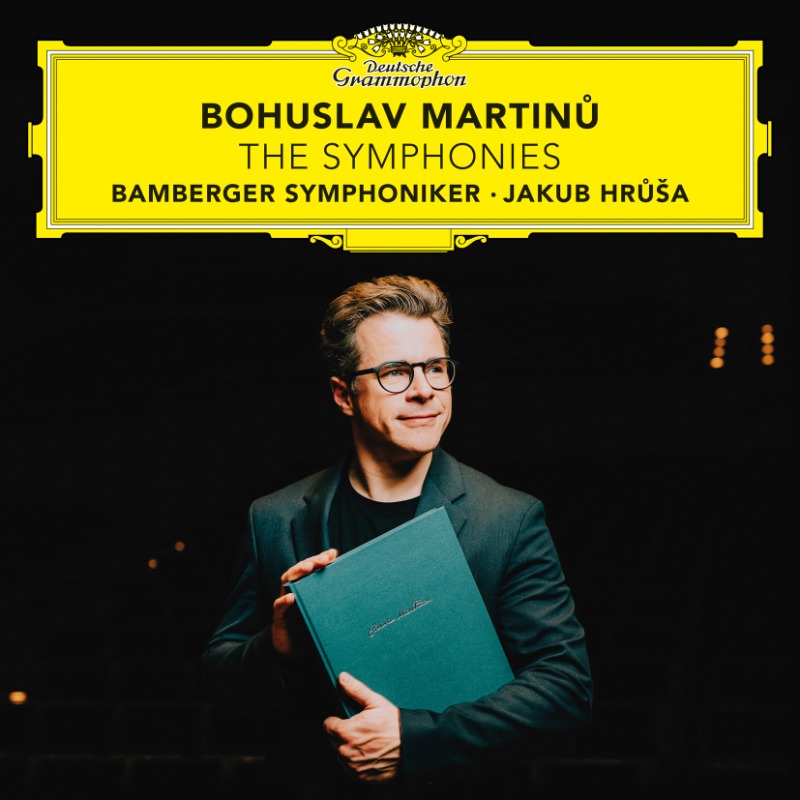
The timing carries its symbolism. The Bamberger Symphoniker marks both its 80th anniversary – its founding musicians were largely drawn from Prague's German Philharmonic – and the tenth year of Jakub Hrůša's tenure as chief conductor. The awards have followed accordingly: Musical America named Hrůša its 2026 Conductor of the Year, while the ICMA gave him Artist of the Year and the orchestra a Special Achievement Award, commending his restoration of the ensemble's distinctively Bohemian character. Listening to these performances, one understands the judges' enthusiasm entirely.
Martinů came to the symphony late. A prolific composer from his twenties, he wrote no work in the genre until his fifties, driven to it by the upheaval of exile — he and his wife fled Paris ahead of the Nazi advance, eventually sailing from Lisbon to New York in March 1941. All six symphonies were composed between 1942 and 1953, a concentrated outpouring shaped by displacement, longing, and hard-won hope.
The First Symphony announces his qualities immediately. From its opening bars, the swell of sound from the Bamberger strings is magnificent — warm, full-bodied, and unmistakably characterful. Martinů's melodic gift is apparent from the outset, and Hrůša draws it out with a conductor's instinct that speaks of deep familiarity rather than mere technical command. The third-movement Largo is particularly impressive, the piano writing emerging with exceptional clarity and poise.
What becomes apparent across all six works is what a superlative orchestrator Martinů was. There is a potpourri of moods and textures that absorbs the listener entirely — music that is melodic and radiant but never superficial. Hrůša understands that each symphony has its own personality, and his readings honour that distinction without imposing a uniform interpretive gloss. The playing throughout is elegant and suave, every section reaching deep into the scores so that the music scintillates, and where humour is called for, it is delivered with a light touch rather than a laboured effect.
The Fourth Symphony's Poco Allegro is electrifying — the tempo, crescendo and percussion combine in a propulsive, dramatic arc that leaves one genuinely breathless. The rhythmic energy and syncopation that drive this cycle are consistently compelling. The Third Symphony receives a particularly fine reading, Hrůša capturing its darkness with conviction; the closing string writing, accompanied by woodwind, is quite superb. And the sixth – originally titled Fantaisies symphoniques in a nod to Berlioz and described by the composer himself as "a departure from symmetry in the direction of fantasy" – receives an extremely powerful performance, its singular imaginative world fully inhabited.