

Andrew Palmer, Group Editor
Classical Music: House of Wonder – Sally Beamish Celebrates 70 Years
Sally Beamish April; Crescent I Swing, II. Midnight Blue, III. Etude, IV. Canonbury, V. Hide and Seek; Gerropaedie; Wide Night; Night Songs; Prelude and Canon; FirstPeace; Glanz; Laurie Irvine Lurk; Karin Rehnqvist Cradle Song; Tom Irvine Where are you; Stephanie Irvine House of Wonder; Joseph Havlat Aquamarine Depths; Christ Stout and Catriona McKay Sally’s Tune.
Sally Beamish viola, Ryan Corbett accordion, Joseph Havlat piano, Stephanie Irvine lever harp & voice, Peter Thomson speaker, Rosalind Ventris viola, Imogen Whitehead trumpet.
Delphian DCD34333
https://www.delphianrecords.com/
Crescent, a five-movement work, is melancholic in cast, with piano and trumpet contributing to its shifting textures. Beamish's command of string writing is evident in every phrase—her understanding of how to exploit different bowing techniques and how to balance intensity with restraint marks her compositional voice as quite distinctive. The third piece, Étude, grows from a syncopated bowing pattern encountered during recent jazz lessons, and its energy is irresistible, but the piece also works as a form of memory, evoking the music-saturated Barnsbury house of Beamish's childhood, where her viola or piano practice overlapped with her mother's violin, her father's flute, and her brother's trumpet. The domestic soundworld becomes a kind of inherited polyphony.
Hide and Seek is one of the album's most delightful inventions. Its opening melody is spun from the letters of Beamish's own name—S-F-B-E-A-m-i-S-H—translated into pitch using German and French conventions: the E flats becoming "Es," the H becoming B natural, and the "mi" serving as E in French solfège. After this musical signature has been established, the trumpet catches the spirit, and one imagines children tip-toeing through unfamiliar rooms, searching and hiding in equal measure.
Gerropaedie—a playful glance at Satie's Gymnopédies—began life as an eightieth birthday gift for Beamish's close friend and patron, Dr. Gerry Mattock, a pioneering environmental scientist. The harp is a lovely accompaniment to the viola here; the music is still pondering. Its original version was written for harp and cello, composed specifically for Stephanie Irvine and her father, the cellist Robert Irvine, to perform together for Mattock. That original, family occasion gives the piece its particular tenderness.
The song cycle Night Songs is the album's most expansive sequence. In Sleep Now (Cradle Song), the piano's enchanting accompaniment yields gradually to the viola and then to the spoken voice of Beamish's husband, Peter Thomson, whose delivery is quietly captivating. Beamish's setting shares the same text as a piece by Karin Rehnqvist, and the two composers approach the material very differently; hearing them in succession is a revelatory exercise in how language and music can inflect each other. The articulation in both the human voice and the viola punctuates the dynamics with precision, and both settings hold the listener in a near-hypnotic state. The third Night Song, Blues, introduces syncopation and blue-note inflections to memorable effect, its ending particularly well-judged.
Beamish's son, Laurie Irvine, contributes Lurk, which makes effective use of the accordion and viola combination introduced in April, with the rhythmic interplay between the instruments generating a quiet momentum. Her other son, Tom, offers Where You Are, a solo viola work of considerable emotional intensity. It begins as a solemn lament, with phrases that arise and slowly fade; the emotional tension is deep and sustained, and one is left wondering quite what it costs a composer to write something so nakedly felt for a parent to perform.
The title track, House of Wonder, is contributed by Stephanie Irvine, who also provides viola, harp, and voice. Its theme and the harp's accompaniment complement each other with natural ease, and Irvine's own sung voice rhythmically illuminates moments of quiet sublimity. Andrew Stewart's excellent notes tell us that the house of the title is the summerhouse where Beamish spent countless hours in composition; Stephanie knew nothing of what her mother did there, only that it made her happy, and something of that wondering perception seems to inhabit the music. The piece carries, too, a suggestion of Irvine's Scottish roots, something perhaps impossible to define and yet wholly audible.
Among the contributions from outside the family, Joseph Havlat's Aquamarine Depths produces the musical equivalent of onomatopoeia, capturing the quality and motion of water with considerable ingenuity. Sally's Tune, by Chris Stout and Catriona McKay, is a duo for viola and harp that draws warmly on Celtic tradition, its directness a relief after more complex emotional terrain.
The album closes with FirstPeace, for solo trumpet, just over a minute in duration. Written in 2024—a year in which peace was, as Beamish reflects, "but a vanishing hope for millions"—the piece spells out "peace" in Morse code before ending with the British military's 1918 ceasefire call. Thoughtful without being heavy-handed, it brings the disc to a quiet, sobering close.
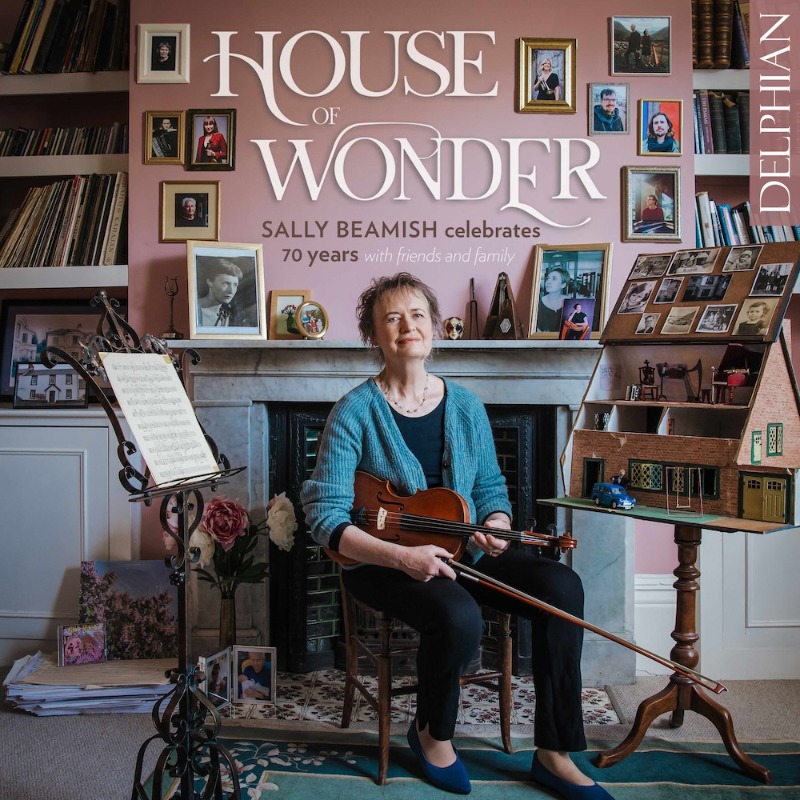
Ryan Corbett on accordion, Rosalind Ventris on viola, and Imogen Whitehead on harp and piano—and the other collaborators gathered here—perform with unfailing sensitivity. Beamish's own playing is eloquent and completely committed throughout. The atmospheric cover photograph, with its framed family portraits, sets the tone for what is, finally, an album about love: for music, for family, and for the viola itself.