

Andrew Palmer, Group Editor
Classical Music: Vaughan Williams A Sea Symphony
Sir Antonio Pappano
Masabane Cecilia Rangwanasha (soprano), Will Liverman (baritone), London Symphony Orchestra
London Symphony Chorus, (Mariana Rosas Chorus Director).
LSO Live SO0910
Recorded live in DSD, February 2025, Barbican Hall, London
https://lsolive.lso.co.uk//
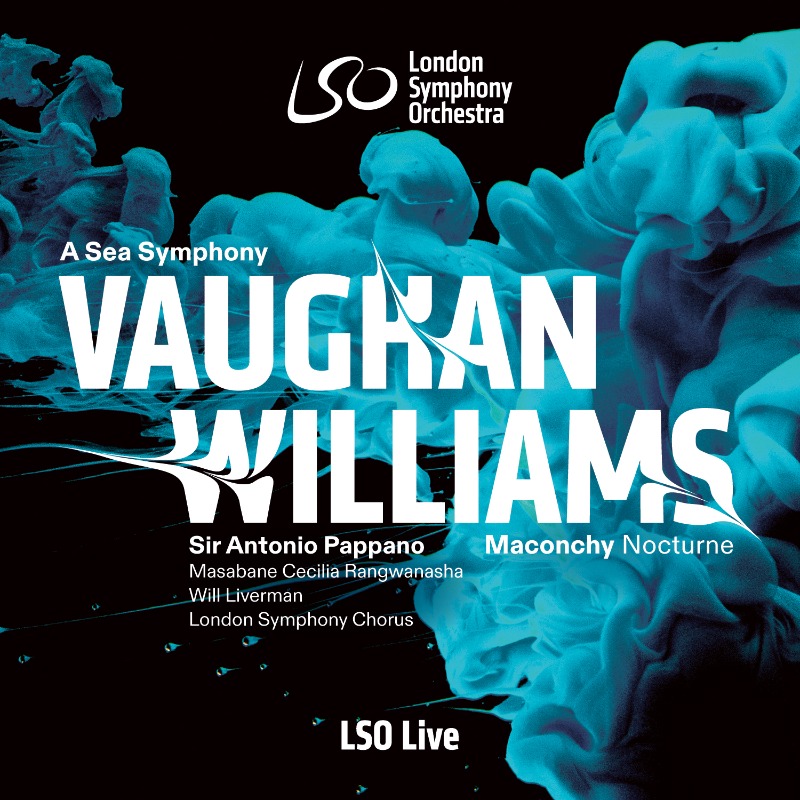
When Vaughan Williams completed the work in 1910, no British composer had built an entire symphony around a chorus before. He set Walt Whitman’s prophetic, far-seeing verse adrift on a tide of choral and orchestral sound, and the result is an odyssey on the grandest scale. This release marks the latest port of call in Pappano’s Vaughan Williams cycle with the LSO.
'A Song for All Seas, All Ships' is a delight from the first bar. Vaughan Williams honours Whitman’s words with vivid word painting, and his orchestration glitters throughout, not least the piccolo, which darts across the texture like sunlight catching the spray. Such is the sweep of the playing that I found myself instinctively bracing against the roll of the waves, while sitting very firmly in my armchair in Ripon.
The balance between voices and orchestra is exemplary. Even when the full orchestral tide comes crashing in, the chorus is never swamped, no small achievement given that several who heard these concerts in the hall felt the words were lost beneath the waves. The London Symphony Chorus clearly relish every page, singing with a split-second unanimity that only comes from meticulous rehearsal, every entry landing as cleanly as an anchor dropping into still water. Their unaccompanied passages are gorgeous, and the hushed closing pages, where the music slips away into silence like a vessel vanishing into sea mist, are handled with complete poise.
Soprano Masabane Cecilia Rangwanasha sings with a voice that glows like polished brass, and every word reaches the listener crystal clear. American baritone Will Liverman is at his finest in the second movement, 'On the Beach at Night, Alone', where he inhabits Whitman’s lines as though they were his own thoughts. In the grander climaxes I would have welcomed a little more heft, a quibble that barely ruffles the surface of an otherwise superb reading.
Pappano conducts from David Matthews’s new edition of the score, published by Stainer & Bell in 2025. Its most notable addition is an organ part for the 'Scherzo', taken from Vaughan Williams’s own marked-up copy. Many of the other revisions stem from a letter the composer sent to Adrian Boult in 1945 with second thoughts on the scoring. The change you notice first comes in the opening two bars, where trombones now take the part once given to horns; others are so subtle you would need the score open on your knee to catch them. The effect is rather like welcoming a well-loved ship back from dry dock, familiar in every line yet gleaming with a few new fittings.
Pappano, who has truly got beneath RVW’s skin during this cycle, never hurries the swell. He lets us gaze out at the far horizon and sense the immense power gathering below the surface, and the score’s finest filigree rises to meet us like phosphorescence in a ship’s wake. Everything is in place, and the percussion are on sparkling form, the cymbals flashing like sun on a breaking crest.
Rounding off the disc is Elizabeth Maconchy’s Nocturne for Orchestra of 1950, a perfect companion piece. Maconchy was a pupil of Vaughan Williams, but you will search in vain here for the hedgerows and cowslips of English pastoral; her ear was tuned instead to the harmonic adventures of Bartók and the Continental avant-garde. The music conjures a night of quiet reflection, shot through with a faint sense of unease, and the published score carries lines from Coleridge’s marginal gloss to The Rime of the Ancient Mariner, in which the moon travels steadily across the sky. Maconchy captures that image beautifully. As moonlight silvers the waves, the strings weave their spell, while harp, celesta, muted trumpet and woodwind wink in and out of the darkness like distant lighthouses along a sleeping coast.
The Nocturne rarely finds its way into concert programmes, which makes its inclusion here all the more welcome. After the vast canvas of the symphony, it is like stepping out on deck once the storm has passed, to find the sea calm and the moon keeping watch. Pappano’s cycle has been a voyage worth taking from the outset; with this release, it reaches open water.