

Andrew Palmer, Group Editor
Classical Music: Verdi Requiem
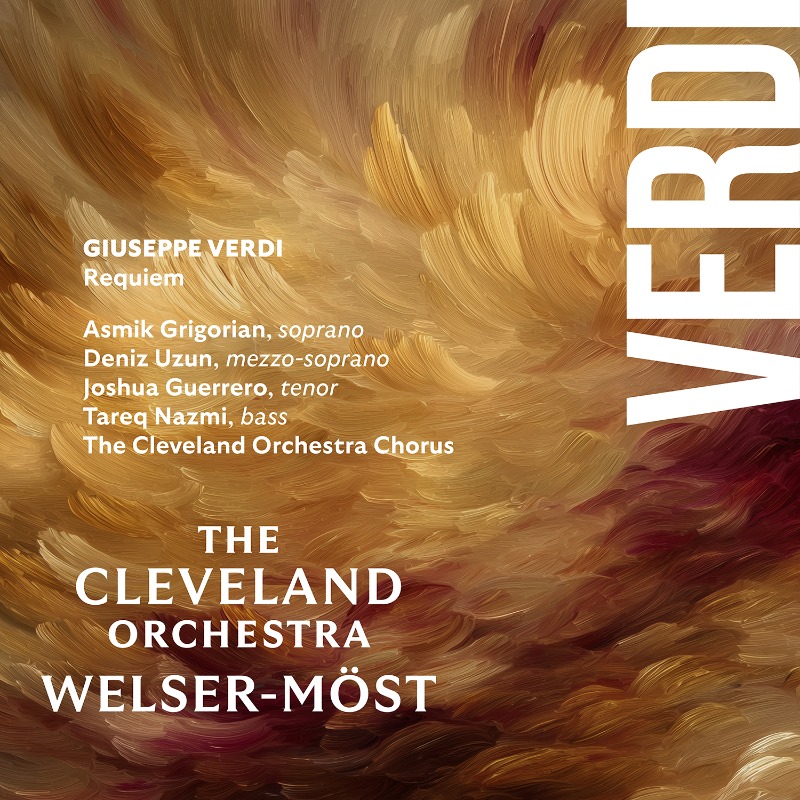
The Cleveland Orchestra
Franz Welser-Möst, conductor
Asmik Grigorian, soprano; Deniz Uzun, mezzo-soprano; Joshua Guerrero, tenor; Tareq Nazmi, bass.
The Cleveland Orchestra Chorus
Lisa Wong Director of Choruses
A TCO Media Production TCO0019
That balance is where the recording earns its keep. The Mors stupebit trumpet calls arrive with genuine spatial separation from the strings beneath them, and the Tuba mirum's off-stage brass genuinely does feel off to one side rather than merely quieter — a small engineering triumph that a conventional stereo capture would have flattened. Through it all, Franz Welser-Möst, in his twenty-fifth and final season with the orchestra, holds the accompaniment and the drama in superb equilibrium, so that the Dies irae's thundering chords never simply overwhelm the ear but retain their shape and their terror in equal measure.
The orchestra's own playing more than earns its place alongside the voices. The cellos open the Requiem aeternam with a hushed, beautifully weighted pianissimo that sets the tone for everything to follow, and the strings sustain that quality of listening throughout — never merely accompanying, but shading and colouring each solo line, most touchingly in the desolate string writing beneath the Lacrimosa. Welser-Möst draws playing of real character from the woodwind too, their solo interjections given space to breathe rather than being swallowed by the chorus, while the lower strings and timpani lend the Dies irae's opening hammer-blows a weight that never tips into mere noise. It is a performance built on contrast: the same players who deliver the Tuba mirum's brass with such visceral force bring a chamber-like delicacy to the Offertorio, and Welser-Möst's control of that range, from whisper to eruption, is arguably the recording's single greatest achievement.
It is the chorus, trained by Director of Choruses Lisa Wong, that impresses first. Drawn entirely from volunteers, The Cleveland Orchestra Chorus brings off the eight-part fugue of the Sanctus with a clarity and lightness that professional choirs often struggle to match, and their pianissimo work in the Lacrimosa is genuinely affecting rather than merely quiet.
Among the soloists, Tareq Nazmi's bass is the performance's still centre: warm and unhurried in its lower register, with a thoughtful, dignified account of the Confutatis that never resorts to bluster even when Verdi hands him real power to spend. Joshua Guerrero's tenor is sonorous and secure through the Ingemisco, and Deniz Uzun brings a commanding, richly textured mezzo to the Liber scriptus and to her exchanges with Grigorian in the Recordare and Agnus Dei. Asmik Grigorian, meanwhile, is the performance's most operatic voice — radiant and expressive, soaring through her upper register with real ease, though it is in the work's most intimate corners, rather than its grandest, that her singing is at its most affecting. Together, in the Offertorio and the Pie Jesu, the quartet blends with real unanimity, the ensemble singing as carefully weighted as anything in the solo writing.
Verdi wrote his Requiem in memory of the novelist and poet Alessandro Manzoni, folding the drama of his operas into the structure of the Catholic Mass, and few recordings make that hybrid nature quite so audible as this one. As Hugh Macdonald notes in the accompanying booklet, Verdi insisted the Mass should never be "sung in the way one sings an opera" while remaining perfectly content with any voice that was simply beautiful — a contradiction this cast resolves better than most.
Released by the orchestra's own label — its nineteenth issue since the label's 2020 launch, and produced by the seven-time Grammy winner Elaine Martone — this Requiem arrives as Welser-Möst's tenure enters its final stretch. If it proves to be something of a farewell document, it is a formidable one: a performance that trusts Verdi's theatre to speak for itself, and a recording that, for once, lets the listener sit closer to the drama than the hall itself ever could.