

Steve Whitaker, Features Writer
Earth, Fire: Notes On Burials By Jayant Kashyap
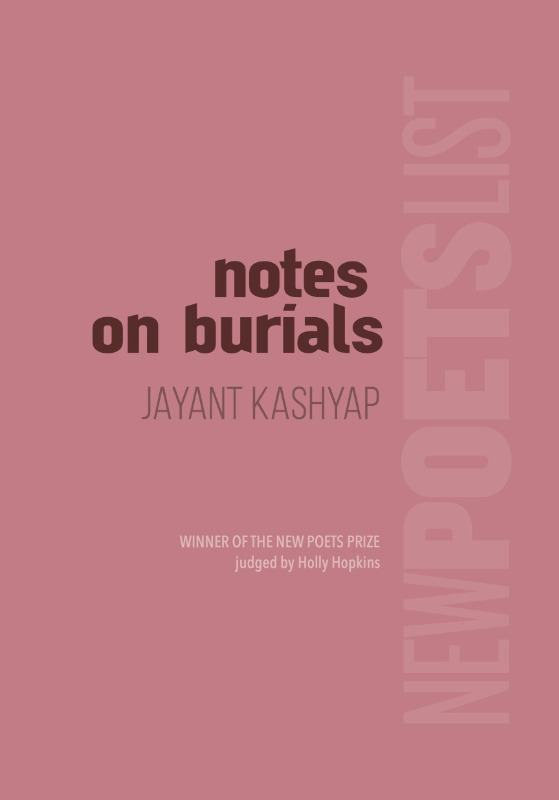
The process is more a means of anchoring the vagueness of cross-border speculation, of reintegrating the totem of death into the fabric of the everyday, and of giving the cultural apprehension of its obsequies currency in any language. The textual effect does not grate, surprisingly; acting, instead to gently coax the reader towards fuller understanding. The poem ‘Carrying’ gives definition to Kashyap’s own religion in which the dead are not buried but borne by water to their place of resting. A languid, rather beautiful reflection, whose tempo mimics the funereal pace of the river, the poem incorporates the cognates of terms from other languages to give figurative body to the poet’s narrative, and to stress the borderless commonality of sound and image. Here, the journey of corporeal abandonment - ‘to clear’, to free from -’ is eased by the refulgent beneficence of its carrier:
‘In carrying, even water is bathed in broken light (from Old
English lèoht, from Greek leukos: ‘white’) from between trees’.
The image is highly visual, seductive even, in the context of a slow, ritualised passage. The trick of light is repeated elsewhere in Kashyap’s chiaroscuro odyssey whose formal approaches are as protean as his subject-matter. The natural impressionism of his style – one cannot escape the feeling that the poet is thinking on his feet – results in inventive forays, an eclectic display of forms that attempt to disinter the meaning of loss, displacement and collective memory. From the fractured narrative of ‘The pastor said the graveyard has now sprouted flowers like a welcome’, whose delicately moving discourse heals the poem’s broken syntax in metaphors of love and flowers, to the staccato lineation of ‘Pyre’, the effect is unerringly persuasive. This last, unusually perceptive meditation weighs the separation of body from soul at death in figures of flame and organic matter, somehow animating inanimate forces with a species of sentience, as though the marginalia of funerals was the handmaiden to release:
‘To dissolve a body of its past, we use incense, we use flame and flowers,
or shovels and soil. And prayers, and pieces of wood. Birds peck at worms in
the logs before fire
embraces the logs of wood.
Wood
helps in transcendence.’
Dissolution is made unitary here, obliging the means into symbiotic, cross-cultural concord in obeisance to a single metaphysical aim. The act of reconciliation is one component of Kashyap’s wider intention in a collection that traverses borders to encompass both the poet’s own experience and the multiplying eye of his focus. His episodic poem, ‘London, Upon Your Arrival’, which includes a luminous epigram from Mandelstam on St Petersburg, excavates the capital, its etymological history and streets as though in a psycho-geographical dreamscape conjured by Peter Ackroyd, and invested with a seductive lyrical edge. A poem of presentiment – an homage both to the narcosis of the city and to expectant love – Kashyap’s narrator is a flâneur of the imagination:
‘We shall meet again. You will visit in autumn, when the leaves will have
covered the walks in colours as though the earth had split herself into
feathers here. As though the ground were painted quince and carmine
and tangerine.’
In similar vein, and in one of the finest poems of an outstanding collection, ‘Dream Sequence’ releases the mind’s shutter-speed to convey both a gentle consideration of a changeful Indian landscape and a catastrophic reordering of the climate in one subconscious leap. If the sparrow in the poem is a ‘harbinger’, a foreshadowing ‘of something warm or bleak’, then the muffling silence of snow in an alien terrain is another form of burial, described, here, with an eye for detail that is the precise metonymic measure of something unanticipated or fearful:
‘flowers washing away from the graves, dogs howling sometimes
from inside neighbours’ homes.’
More information here.