
12:00 AM 2nd October 2026
Reading between the class lines
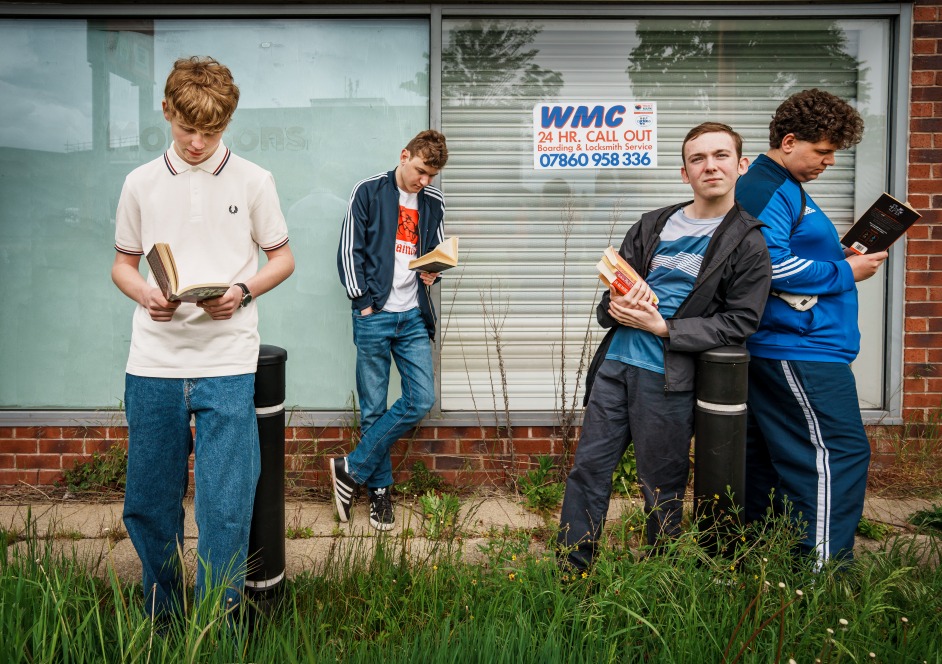
Theo Riley, Lincoln Hague, Jake L. Palmer and Kieran Hazzard turning pages near Wilberforce Sixth Form College in Hull
Photo: Carmina Ripolles
Yet one literary magazine believes the debate rests on a flawed assumption: that working-class people simply don't read.
The Bee, published by the Newcastle-based charity New Writing North, contends that millions of working-class readers are being overlooked because their habits rarely fit the conventional picture of book culture. They borrow from libraries, buy second-hand, swap paperbacks, listen to audiobooks and devour manga and comics online. It is a thriving reading life, but one that tends to slip beneath the radar of publishers, researchers and the media.
Its new special edition, Celebrating the Working-Class Bookworm in the National Year of Reading, is distributed with The Bookseller on 2 October. Through reportage, fiction, essays and discussion, it sets out to make those readers visible, and to challenge the enduring notion that reading is chiefly a middle-class pursuit.
A deficit lens
Editor Richard Benson argues that books have long given working-class readers "an affordable way to escape immediate circumstances, encounter different worlds, make sense of lived experience and imagine different futures".
"Yet public debate around reading increasingly presents class through a deficit lens," he said, "focusing on the people who do not read, rather than the millions who do."
The numbers suggest an industry that may not be seeing its whole audience. Research commissioned by New Writing North in 2025 found that 63 per cent of working-class readers considered representation important and wanted to see more people like themselves on the page. Fewer than 20 per cent of those working in publishing, by contrast, come from working-class backgrounds.
.png)
Kieran Hazzard, Jake L. Palmer, Lincoln Hague, Theo Riley
Photo: Carmina Ripolles
"There are millions of people from working-class backgrounds for whom reading already means escape, pleasure, companionship and discovery," she said, "yet they are still under-represented both on the page and inside the industry. If we want more people to read, we have to make more people feel that books belong to them."
None of this, the magazine stresses, is to wish away genuine disadvantage. A government-backed inquiry published this year by the Star Academies Trust into white working-class educational outcomes found that 36 per cent of white pupils receiving free school meals achieved a grade 4 or above in English, against 72 per cent of pupils not on free school meals.
"There are serious problems around poverty, literacy and access to education, and nobody should minimise them," Benson acknowledged. "But poverty, disadvantage and class are too often collapsed into one another, creating a misleading picture of a uniformly non-reading working class."
The Bee's definition of working class broadly follows the Office for National Statistics approach, based principally on a person's parental occupation at the age of 14.
Readers on the road
For the special edition, Benson travelled across Yorkshire, asking working-class readers what they read, why they read and where their books come from.
Among them is 16-year-old Kieran Hazzard from Hull, who learned to read through regular library visits and went on to help teach his mother to read. Today he reads fantasy, non-fiction and manga, much of the latter online, as the series can be costly to buy.
He is one of four sixth-form boys featured whose tastes stretch from Diary of a Wimpy Kid and manga to Stephen King, George Orwell and Sylvia Plath. Fellow 16-year-old Jake Palmer credits Plath's poetry with seeing him through the breakdown of a friendship. "It kept me going," he told the magazine. "Poetry keeps me going. Reading keeps me going."
One of the group says he would be devastated to lose his local bookshop; another calls his a "second home".
"We talk about young working-class boys so often in terms of failure, poor attainment or antisocial behaviour," Benson observed. "What we hear much less about are boys like Jake and Kieran: reading poetry, writing their own work, spending time in bookshops and using books to make sense of their lives. If we only ever look for deficit, that is all we will see."
At the other end of the age range is 85-year-old Maureen Thomson, who has read throughout a working life spent in guest houses and factories and on the land. She now trades historical romances with friends and through a supermarket book exchange. For her, those novels speak to the lives of her mother and grandmother, both of whom worked in domestic service; women whose experiences seldom found their way into conventional histories.
That informal economy of charity shops, second-hand sellers, book-swap tables, borrowed copies, audiobooks and online comics is, the magazine suggests, almost invisible to the publishing trade. Benson urges caution against dismissing such reading "simply because they sit outside the parts of reading culture the publishing industry finds easiest to see or value".
A Booker winner's view
The argument has recently found a prominent champion in Douglas Stuart, the Booker Prize-winning author shortlisted again this year, who has taken issue with the idea of books as a middle-class pastime. The most loyal library patrons and the most voracious readers he knows, he has said, are the women he grew up with, and he counts seeing Shuggie Bain top the discount supermarket charts among his proudest moments.
Benson is careful not to deny the crisis altogether, only to question how it has been measured.
"Working-class Britain does read – in libraries, on buses, in bedrooms and factories," he said. "It reads romances and comics, audiobooks and poetry. It borrows, swaps, lends and buys second-hand."
The missing readers, in other words, may never have been missing at all. They were simply on the bus, with a dog-eared romance from the supermarket swap table, while the industry was looking the other way.