

Andrew Liddle, Guest Writer
Show & Tell In Scarborough
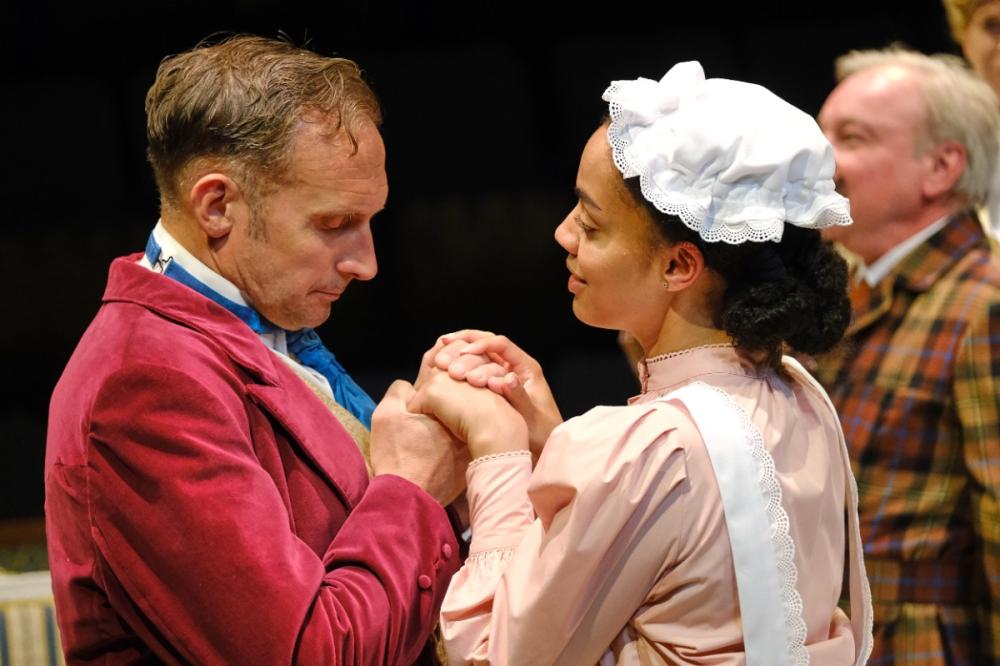
(L-R) Richard Stacey, Olivia Woolhouse, Paul Kemp
Photo: Tony Bartholomew
A perceptive critic of his times, whose plays operate on many levels of seriousness and comedy, he loves to keep the audience in a permanent state of unease, uncertain whether to laugh out loud too much, smile reflectively or even occasionally wince in pain. Show and Tell, his 90th, which he directs himself, is amazingly absorbing, captivating and provocative. Beautifully written and terribly clever in its use and abuse of conventions, it moves from dark to light, from the claustrophobic naturalism of old age to the follies and vices of French farce.
Making a nonsense of the sort of strict genre theory beloved of academic highbrows, it harks back to the golden age of repertory when hard-working actors had to make and mend, had to put on a different show every week with no time to think about their ‘performance philosophy’. This was the theatrical world that Sir Alan originally worked in as an actor. His mentor, Stephen Joseph, whose name is celebrated in Scarborough’s SJT Theatre, was a great pioneer of theatre-in-the-round and fervent advocate of taking drama to the people.
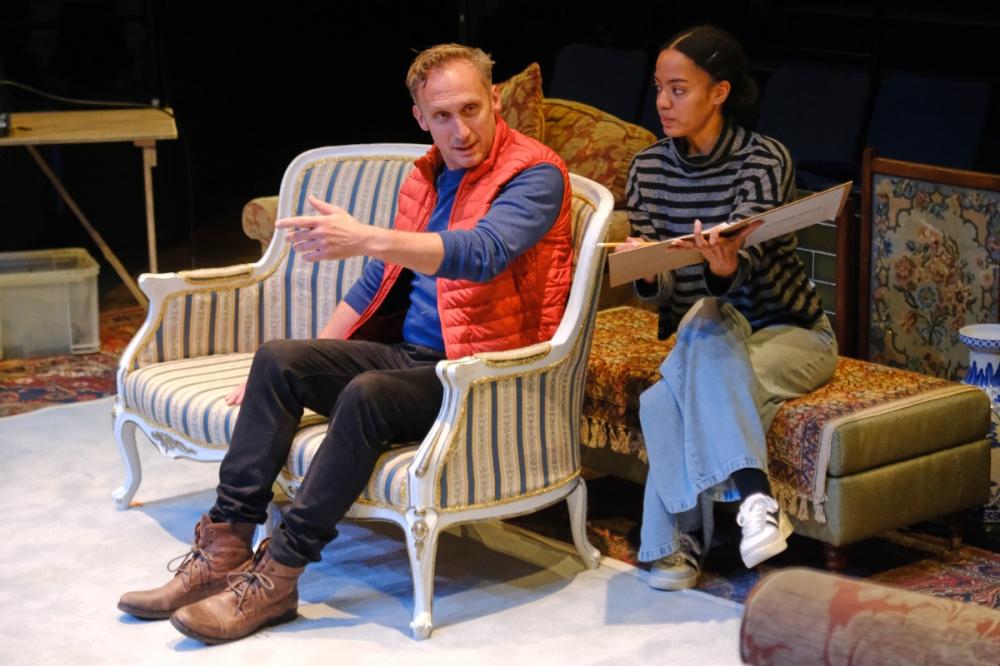
(L-R)Richard Stacey, Olivia Woolhouse
Photo: Tony Bartholomew
Bill Champion, no stranger to these boards, brings a great deal of sensitivity to the portrayal of someone who, shall we say most kindly, is getting forgetful and tends to live in the past. Richard Stacey acutely judges the strengths and weaknesses of the young actor, Peter Reeder, who arrives to discuss the show, a one-act French comedy. Down on his luck and desperate to get a booking, he can’t help despairing at the suitability of this one. The laughter is polite and restrained, directed towards the concept of misunderstanding rather than its prevalence in old age, as Jack persists in his belief he’s talking to someone from the electricity board.
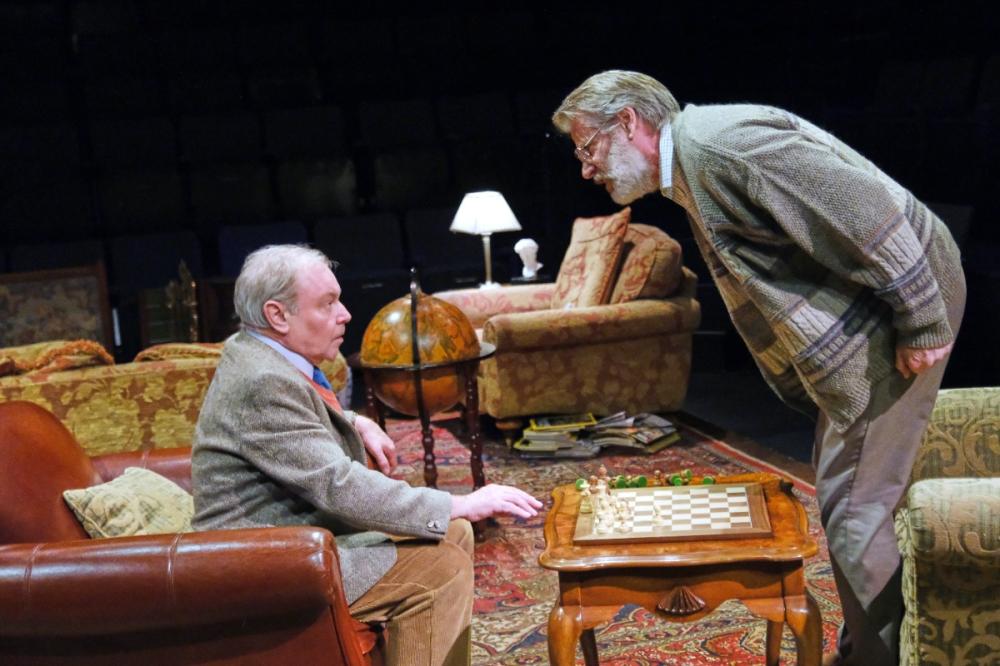
(L-R) Paul Kemp, Bill Champion
Photo: Tony Bartholomew
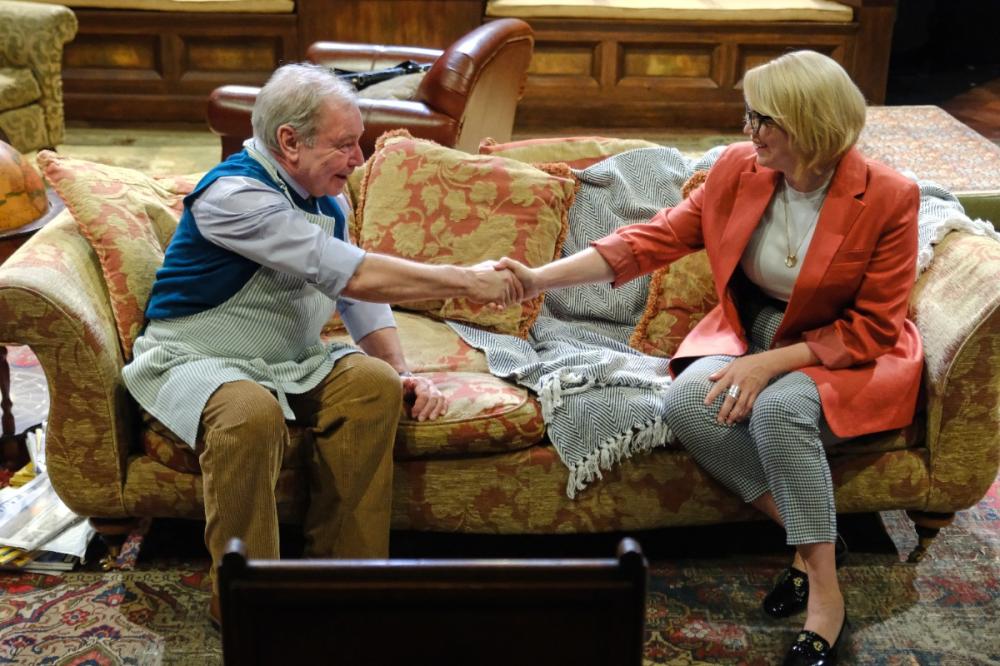
(L-R) Paul Kemp, Frances Marshall
Photo: Tony Bartholomew
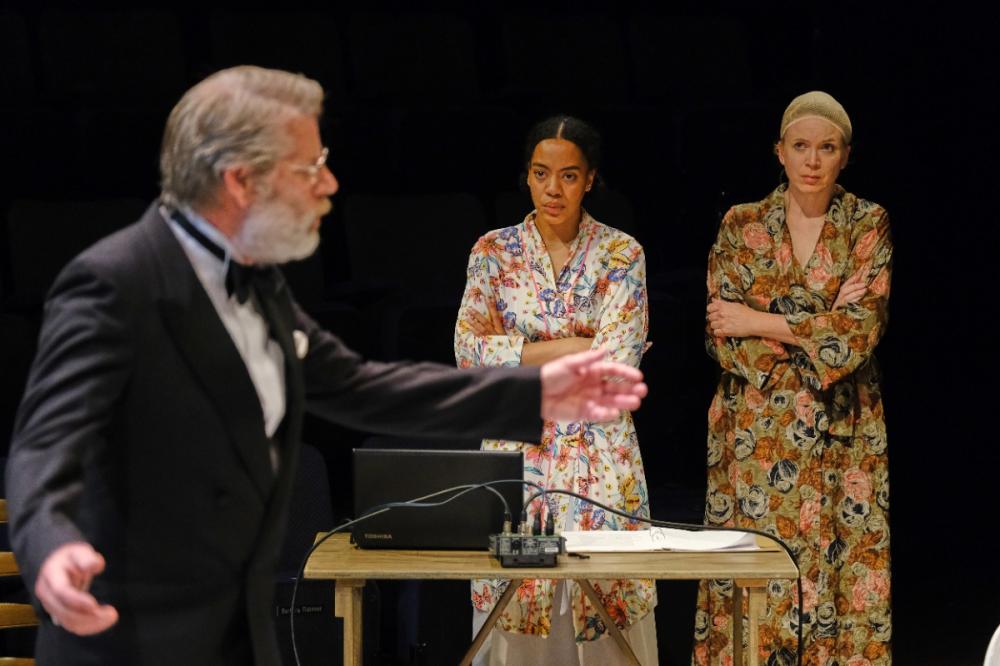
(L-R) Bill Champion, Olivia Woolhouse, Frances Marshall
Photo: Tony Bartholomew
There is no dominating presence or central consciousness but Jack’s former Head of Gentlemen’s Outfitting, Ben Wilkes, comes close to stealing the show, played by the redoubtable, much travelled Paul Kemp. Without wishing to give too much away, it must be said Ben is not what he at first seems and really comes out of himself in the second act, revealing surprising talents. His former relationship with Jack’s wife, Alice, creates a tension that we edgily suspect might lead to serious conflict, especially when we later see him casually sporting the old Chekhovian shotgun, a theatrical trope that Ayckbourn cheerfully drops in.
We wonder how the crowded set (designed by Kevin Jenkins), an old person’s home, all easy chairs and settees, footstools and family photographs, will double as an elegant chateau - before remembering this is performance-based theatre and the imagination can supply the trappings. Of course, we are doing that already because this is theatre-in-the-round and we have dispensed with the so-called fourth wall of a conventional stage.
Ayckbourn, most of whose plays have premiered in Scarborough, is the great champion of this and uses it to brilliantly optimal effect in the play’s second half. Here we rejoice in the greatest of all meta-theatrical devices, the play within the play, where we the audience are notionally watching Jack, his wife and guests while they, like us, are being entertained by the players. Without knowing it, we have become Jack’s guests; we are in his house, as caught up in the play as he is, while simultaneously mindful of the play he is part of. It’s clever. It’s pure Ayckbourn. It’s great fun. It has us on the edge of our seats.
And it really is a rather fine one-act farce with stock characters. Stacey excels in stepping out of the shoes of the unemployed jobbing actor, to blossom on stage as the rakish aristocrat. In fact he positively relishes the role once in costume, throwing off all his earlier cynicism. Frances Marshall, another with several Ayckbourn successes under her belt, is delightful as Harriet, the troupe’s owner and driving force, posturing wildly in the role of young wife deceiving the aged doting husband. No French farce (or comic opera) would be complete without the knowing servant, more worldly wise than her mistress, and Olivia Woolhouse, making her stage debut, is outstanding.
It’s a delightfully funny send-up but this, being the work of the master, will the two 'plays' become seriously entangled before the unpredictable dénouement? Show and Tell, which runs at the SJT, Scarborough until 5th October, is a must-see. It’s vintage stuff, the sort of theatre that will gladden your heart but perhaps make you want to think about how close to farce our reality is.
Alan Ayckbourn’s 90th play is a celebration of theatre, a delightfully dark farce lifting the lid on the performances we act out on a daily basis.
More information here