

Andrew Liddle, Guest Writer
The Unexpected Professor, John Carey
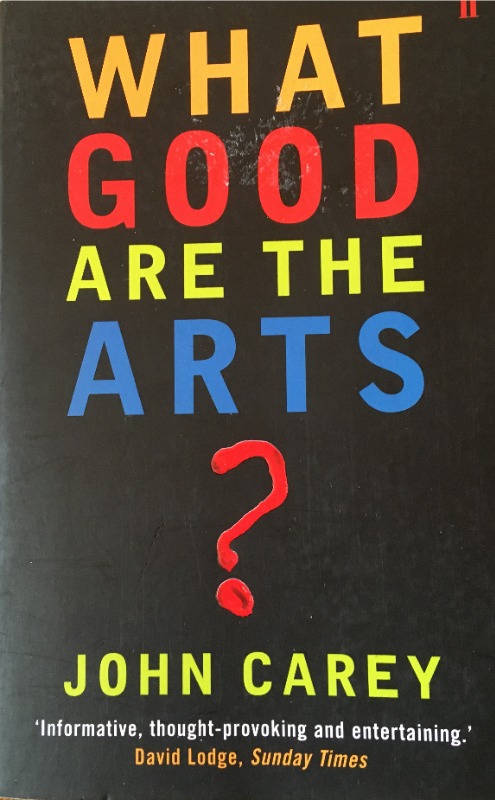
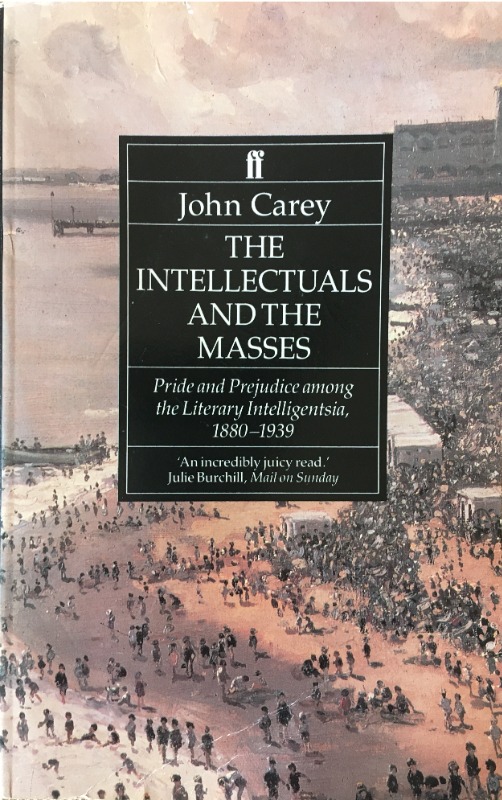
He’s one of my heroes, not least for his provocative stance on the arts, the Oxbridge establishments’ snobberies and absurd rituals and the metropolitan elite’s profound shallowness. These he beautifully articulates in bestsellers like The Intellectuals and the Masses and What Good Are the Arts?
.jpg)
Professor John Carey, photographed on 14 March 2014 (cropped from the original photo taken by Freddie Phillips). Photo from WikiPedia
Actually without ever meeting him, I feel I know him rather well, not only from his books and reviews for the Sunday Times but from his many appearances on radio and TV programmes including Saturday Review and Newsnight Review.
From his essay ‘Down with the Dons’ we know this man of many parts, this wide and voracious reader and ardent bee-keeper, was not exactly enamoured of all his colleagues or his profession. His autobiographical work The Unexpected Professor reveals a man who used humour and superior scholarship as weapons against class prejudice. It makes clear he did not take the prescribed, well-trodden establishment route on his meteoric rise to the most prestigious Chair at Merton - Oxford’s oldest literary professorship - at the remarkably early age of 40.
In fact he came from a very ordinary background in southwest London. The grammar school boy from Barnes, Surrey, the first member of his family to go to university, grew up during the War and retains vivid memories of London Docks burning, bombed by the Germans in 1939, and being evacuated to rural Nottinghamshire. It’s tempting to wonder if his spell in the north gave him some of the grit and determination he later displayed.
His two years of National Service with the East Surrey Regiment were spent in Egypt which, unlike many future academics, he seems to have enjoyed, finding that what he learned “pretending to be a soldier and pretending to be an officer” served him well in civilian life.
In an interview on his life and work, in 2010, he spoke of the “peaceful soldiering”, as being “very educative because …. I didn’t really know anything about the Army and thought of it, I suppose, with a sort of slight contempt.” He found the people he met to be “actually extraordinarily interesting and admirable” and the two years “gave me habits that have lasted, like punctuality … and keeping fit.”
After being demobbed, he gained an open scholarship to St John’s Oxford, in 1954, where he was frustrated to discover the syllabus started with the Anglo-Saxons and ended in 1832.“The unspoken assumption seemed to be that any gentleman would acquaint himself with the Victorian poets and novelists, without needing to study them, and modern writing was not worth serious attention anyway.”

Now it’s one thing to entertain anti-elitist sympathies these days but it was quite another in 1950s’ Oxford. Even his great admiration of the author of 1984 (“My mentor was George Orwell. He is a secular saint. His letters and journals changed me”) made him slightly suspect. From Orwell, he drew the lesson that you should not only acquire knowledge but impart it in a way accessible to a large audience, far beyond the confines of the university.
In the same interview he reveals more. “Because I’d been to a grammar school, I didn’t feel at ease with the kind of elitism that a public school almost inevitably instils, you know, the use of language or ideas to exclude some people was antipathetic to me from quite early on.”
Among many priceless insights into the world he gatecrashed, originally with a London accent and conspicuous lack of urbanity, an incident of pure class snobbery stands out. It occurred when he was doing some temporary teaching for Christ Church, then the most elitist and socially exclusive of the colleges. The fellow of the college, the eminent economist and biographer of Keynes, Sir Roy Harrod, went out of his way to ignore him. "One night I was sitting opposite him at dinner when he had a guest, for whose benefit he was identifying the various notables seated round the table. I heard his guest ask who I was, and Harrod replied, quite audibly, 'Oh, that's nobody'." Carey believes Harrod "and people of his ilk" would similarly "have despised my father.”
In the 2010 interview, while discussing Christopher Ricks’s book on Bob Dylan, he says: “It’s not clear to me why authors and artists [worthy of academic study and analysis] cannot come from pop culture.” While disagreeing with this critic’s assessment of Dylan being “as good as Shakespeare and Keats,” he is nevertheless prepared to take the claim seriously because Ricks “is the greatest critic writing, actually – an astoundingly intelligent man.”
For those like me who studied English - albeit at a redbrick university - before the great cultural sea-change in the 1990s, Carey is an authoritative figure, a revered name like the aforementioned Ricks, and F.R. Leavis and Frank Kermode to list but three. Unlike these, however, to my mind he never fails to impart a sense of the sheer pleasure to be found in the author under discussion.
His style, though always learned, is never anything less than accessible.That clarity of thought, and precision of expression he admired in Orwell is certainly a feature of all his many books, on authors as widely divergent as Milton, Dickens, Donne,Thackeray, Orwell and William Golding.
Carey’s aim and achievement is always to insist that literature is open to anyone and that reading is a rich, joyful lifelong experience. He is par excellence the plain man’s champion, the unacademic academic, one of the very few great critics who does not parade his learning but invites the reader to share it.
I wish he’d taught me. I say again, Happy Birthday, Professor!