

Artis-Ann , Features Writer
Yuanfen: The Beekeeper Of Aleppo By Christy Lefteri
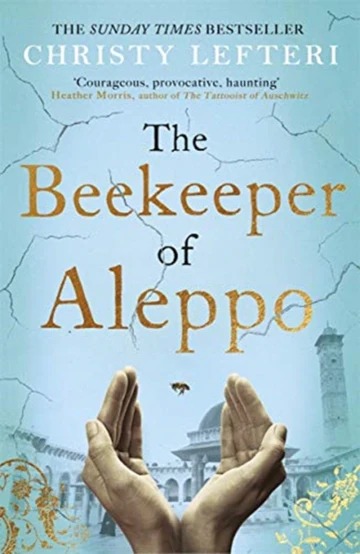
This powerful and beautifully written novel tells the story of Nuri Ibrahim, a beekeeper, and his wife, Afra, an artist. At the beginning, we share their simple life, among family and friends, in the beautiful Syrian city of Aleppo - until war destroys everything they hold dear. As things become ever more dangerous, with bombs exploding, random killings and beheadings of innocent men, women and children, family, friends and neighbours, and the loss of their livelihood when the beehives are wantonly destroyed, Nuri and Afra are forced to make a harrowing, traumatic journey from Syria, through Turkey and Greece, to the UK.
This powerful and beautifully written novel tells the story of Nuri Ibrahim, a beekeeper, and his wife, Afra, an artist.
They hope to meet up once more with Nuri's beekeeping partner and cousin, Mustafa, who urges Nuri to find a way to get to Yorkshire. Mustafa has made the perilous journey ahead of them and has started an apiary where he is training other refugees to raise bees. Afra, made blind by seeing the most heart-breaking vision of all, is broken by all that they have lost. Nuri has to persuade her to make the journey with him and then he must find the strength to support her in the face of danger and desperation: ‘It was a terrible journey, much worse than [you] could have even imagined...[it] had stolen Afra’s soul.’ I never thought I would be sitting down somewhere, next to other families, drinking coffee, without the sound of bombs, without the fear of snipers
It takes time to realise that Nuri’s narration is sometimes in the past and sometimes in the present, sometimes real and sometimes the stuff of dreams and imagination. He is not as well as he would have people think and only Afra knows. Blossoms on the trees become golden keys, and seagulls are white planes, dropping bombs all around him. With the loss of his son, Sami, it is no surprise that he should want to adopt Mohammed, the little boy with the darkest eyes, who seems so often to elude him. Afra tells him, ‘You are lost in the darkness’ and eventually, Nuri admits it.The reader travels with them, through countries which are not always friendly, and across tumultuous seas, sharing their pain, discomfort and fear. They face endless bureaucracy, always fearing the decision that they cannot continue and must turn back. They seek to build a home away from persecution, war, and the surety of death.
All that they know is gone and it is hard to imagine how anyone can have the hope and willpower to keep fighting under such circumstances. As Nuri says at one point, ‘I never thought I would be sitting down somewhere, next to other families, drinking coffee, without the sound of bombs, without the fear of snipers.’ When Nuri and Mustafa eventually meet, ‘two men battered by life’, I defy you not to cry. In their journey, Nuri and Afra have also lost each other and it is only when they realise this, that they can try to find love once more.
In the Author’s Note, Christy Lefteri convinces us that she knows what she is writing about because she worked with refugees, witnessed their suffering for herself and did what she could to help them. She tells us, ‘Bees are a symbol of vulnerability and life and love…The Beekeeper of Aleppo is about profound loss but it is also about love and finding light.’
This novel reminds me of a beautiful poem by Carol Rumens - The Emigree, which includes the lines:
There once was a country…I left it as a child
But my memory of it is sunlight clear…
It may be at war, it may be sick with tyrants
Forced from your home like Nuri and Afra, it is hard for others to comprehend the sense of loss, not just of belongings, things, but also of belonging, and of needing somewhere to call home, where you can learn to live and love once more.
The Beekeeper of Aleppo is published by Manilla Press